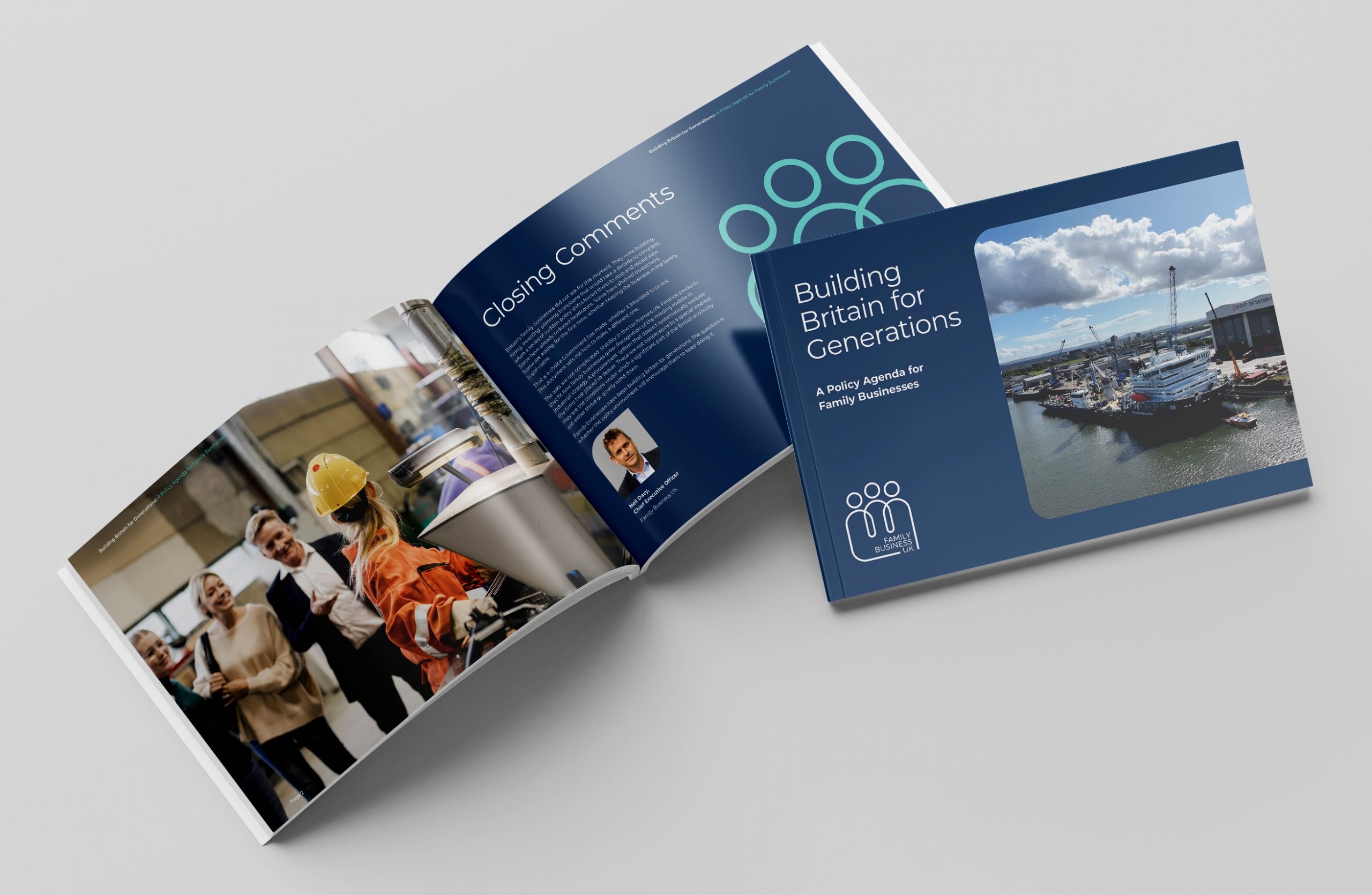
FAMILY first approach in new FBUK policy agenda

FBUK has published a new policy agenda for family businesses. Coming ahead of local elections around the UK and ongoing geopolitical uncertainty, Building Britain for Generations highlights key areas for policymakers, prioritising stability, long-term growth, investment and stewardship – all traits of family businesses.

The policy agenda calls for government, politicians and all policymakers to adopt a ‘FAMILY first’ approach that encompasses:

  • Fair taxation system
  • Accessing finance and business support
  • Mid-sized family business focus
  • Investing in local communities
  • Lowering the cost of doing business
  • Younger generation focus

FBUK Policy Agenda - Building Britain for Generations

The policy agenda, which was launched at an event in London, proposes a comprehensive set of recommendations that place the UK’s five million family businesses, and the benefits of family ownership, at the heart of efforts to grow the economy and tackle critical issues including youth unemployment.

Policy asks include:

  • Appointing a family business czar in every devolved nation and region to support long-term investment in communities and support greater fiscal devolution,
  • Targeted measures to tackle youth unemployment including an exemption from employer NICs for all family businesses offering Level 4 and above apprenticeships in AI, leadership and management,
  • A clear ‘tax roadmap’ – that gives family businesses confidence about the direction of travel, removes the fear of sudden, damaging surprises and enables long-term investments,
  • Full reinstatement of 100% Inheritance Tax reliefs (BPR and APR) for family firms, with no thresholds,
  • A simplified procurement system that places greater weight on long-term investment and delivery, regional investment and social cohesion.

The new policy agenda also calls on government to adopt a new definition of medium-sized businesses to support the forgotten engine of the UK economy. This should be companies with revenues between £10million-£100million and between 50-499 employees (mid-size is currently defined as fewer than 250 employees and less than £54million revenue).

FBUK research shows there are 10,000 mid-sized family businesses in the UK which employ 1.5 million people and create £140 billion economic output. But these established businesses remain largely invisible to policymakers and are held back by a policy environment designed for either small or large companies.

Neil Davy, CEO Family Business UK said:

“Family businesses are established pillars of Britain’s towns and cities in a way that global brands can never be – they have built a brand, reputation and workforce there, and often it’s the family name above the door.

“Yet the current policy system often favours foreign investment over established, British family businesses with the lure of lucrative tax breaks and other incentives not available to family firms. That has to change if the UK is serious about a robust domestic economy that delivers sustainable, long-term growth.”

The new family business policy agenda, which is launched on the eve of the most significant change to the taxation of British family businesses in 50 years (BPR and APR), also highlights the ongoing impact of the change to inheritance tax reliefs on family businesses:

  • The majority of family businesses (57%) say they will still be materially affected by IHT (despite changes announced by government on 23 Dec),
  • Just 1 in 10 family businesses believe they will escape the tax entirely,
  • Just 74% of family businesses are confident they can remain family-owned in 10 years’ time (down from 91% in the next 3 years) with increasing concerns that the burden of IHT will force businesses to sell up or sell assets – often to foreign-owned corporations – creating further instability for the domestic economy.

But FBUK’s research also shows the positive impact that fully reinstating BPR and APR could have, with almost half (48%) of Britain’s large family businesses saying they would reverse hiring decisions and actively recruit more staff.

Neil Davy continues:

“Recent, sudden policy shifts have forced Britain’s family businesses to pause and recalculate long-terms plans for the future. Some have reduced jobs, other have cut investment and, for the first time, some are asking whether keeping the business in the family is still viable.

“This is a consequence of a choice made by the Government-whether it intended to or not. This policy agenda sets out how it can make a different one. The asks are not complicated, nor are they concessions to a special interest. They are simply the conditions under which a critical part of the British economy will be allowed to thrive.”

FBUK host exclusive 2024 Family Business Visits programme

As part of our unique offering to family businesses, FBUK were delighted to lead an exclusive Family Business visit to Cumbria, as part of our 2024 Family Business Visits programme.

We were delighted to have the opportunity to meet entrepreneur and co-founder (with wife Barbara) John Dunning, and his daughters, 2nd generation business leaders-Sarah Dunning  (Chair) and Jane Lane (Farms director)  at the UK’s first family-owned and operated motorway service area, Tebay Services Farmshop & Kitchen.

Tebay – from farm to fork 

Members were treated to a fascinating, first-hand retelling of the incredible story of the Dunning families diversification from fell farming into the services sector, with the founding of Tebay Services in 1972, after the M6 motorway was built through the family farm.

Having learned their land was to be compulsory purchased for the creation of a service station, entrepreneurs John and Barbara Dunning took both the risk and forward-looking opportunity to found Tebay services, a motorway stop with a distinct difference from the norm.

Local people, local produce, and strong values, are at the heart of a family business built from farm to fork, and from fields into an expansive, impressive enterprise. With the Westmorland Family growing the business over 52-years, to now own and operate a number of high-quality, service areas across the UK, including in Gloucestershire on the M5 & Scotland on the M74.

Investing In the local community

The family have long been local employers and also philanthropists, raising over £600,000 for charities local to their estates, and latterly supporting Kendal-based organic farm and mental health charity Growing Well which will now expand to a second site, thanks to a unique partnership (and £150,00 contribution) from the Westmorland Family, with additional National Lottery funding.

Growing Well at Tebay Services aims to help 100 people a year in Eden and North Cumbria recover from mental health difficulties by volunteering there one day a week for up to a year.

Under the supervision of experienced therapeutic growers and mental health support staff, volunteers, who can be referred by GPs, other health services, or themselves, can rebuild confidence, learn new skills, benefit from peer support and be helped to achieve their goals, such as returning to employment or education.

Volunteers will work in Growing Well’s new market garden enterprise at Tebay Services, which will supply salads and other leafy vegetables fresh every day to the Tebay Services Farmshop & Kitchen, where they will be cooked and served to customers just a few hundred metres from where they are grown.

Heritage & innovation

Today, the family farm still feeds the business, sitting at its heart, and the families heritage is vital. Change and diversification have come with considerable investment made, to enable the farms own locally-reared livestock to be both uniquely, used and sold in the Tebay farm-shop and master butchers.

Tebay (North and South) are much more than a traditional motorway services however, they have become a genuine destination.

Offering the chance for tired motorists, and Cumbrian locals alike, to:
◆ Eat a good meal in the restaurant, or grab a home-made bite to takeaway;
◆ Visit the artisan Butchery – selling the farms lamb & beef, with a strict policy of no-part’s wasted;
◆ Stay in the Westmorland Hotel, with views over the unique, landscape of Cumbria including conference rooms claiming a fell & waterfall backdrop;
◆ Shop in the expansive Farm shop, stocking food, wines & gifts from over 70+ local producers, most sourced from within 30miles of Tebay, or it’s sister co’s at Gloucester and Cairn Lodge;

Family values baked in 

Whilst harnessing a desire, since foundation, to strive for quality and innovation, Tebay also remains a lifeline for the local community who work and trade there.
With the business proud to train their own apprentices annually, including Emily Jackson, the UK’s Apprentice Butcher of the year 2023.

John, and the family business 2nd generation leaders, daughters Chair – Sarah Dunning, and farms director – Jane Lane, inspired us with their own leadership journeys, sharing how they came into the business, plans for the future and allowing us an insight into how the USP has grown the business in-line with their values.

Even at 90 years old, the inspiration and entrepreneurial spark in co-founder John, as told in his book, and in the Channel 4 documentary series “A Lake District farmshop”, is clear to see. With Sarah and Jane championing a wide community of farmers and makers, and nurturing a team of dedicated colleagues who share the family’s commitment to handmade and authentic produce.

Thank you to the family for allowing us such privileged access to a genuinely wonderful location, business, family, and story of truly-lived family values and innovation, triumphing over adversity.

Future Family Business Visits

FBUK run family business visits across the UK, with visits from North Wales to the Midlands, Norfolk to Somerset and Yorkshire in the weeks and months ahead.

Don’t miss out on future family business visits, visit our Events page to view the full 2024 Family Business Visits calendar here.

Not an FBUK Member?  – Email the team today at info@familybusinessuk.org for more information, or to signup for our e-newsletter.

FBUK Responds to “Huge fall in Apprenticeships”

In response to an article in The Times titled “Huge fall in apprenticeships under broken levy” regarding the apprenticeship levy, FBUK’s Chief advocacy officer, Fiona Graham, said;

“The latest research from the Chartered Institute of Personnel and Development (CIPD) reinforces our long-standing argument that the apprenticeship system is simply not working”.

“We hear from family businesses on a daily basis how the system is too complicated, inflexible and burdensome”.

“Family businesses want to train young people and upskill their workforces, but administrative complexities discourage businesses from taking on apprentices. Money, a staggering £4.4billion, that could be used for training is instead returned to the Exchequer without being touched”.

“Quite simply, the current system is holding back the immense potential of family businesses by failing to equip future workforces with the skills, training and support they need, where they need it”.

“To deliver a skills regime that is fit for the future, we need an overhaul of the employee training landscape by refocusing the Apprenticeship Levy and making the skills landscape work for businesses and individuals”.

Future Skills Fund

“The current skills and apprenticeship system needs to be revamped and replaced with a more holistic Future Skills Fund. This fund would provide greater flexibility on how money can be used to encompass apprenticeship support, training and development for existing employees.

“This would allow businesses to use the allocated funding on a wider range of training options and opportunities. Transitioning to a Future Skills Fund would also give businesses greater flexibility and opportunity to use funding for the skills and technical expertise they need. It would better equip local schools and colleges to provide training and skills relevant to the needs of local employers and communities”.

The Future Skills Fund would provide a better deal for employers and employees a number of ways:

➤ Providing greater flexibility in the use of the Fund to support life-long learners and apprentices to study, for example through support of transport or living costs.

➤ Removing barriers between the nations of the UK to ensure money can be spent where it is most needed, not necessarily where it is paid.

➤ Giving businesses a greater say in the development of the local skills landscape and supporting career-long skills development and learning, including when re-entering the workforce after a period of absence.”

END.

Family Business UK is a growing body of Family Businesses working together to create a more prosperous and sustainable future for generations to come.
Find out more FBUK today : www.familybusinessuk.org

Read the 2024 Family Business Manifesto in full here