FBUK react to Andy Burnham’s ‘plan for the economy’

Makerfield MP, Andy Burnham, has unveiled his ideas for the UK economy – including devolving greater powers to directly elected mayors.

In a speech in Manchester setting out a ten-year plan for the economy, the former mayor of Greater Manchester, who is bidding to become the next Prime Minister, said his plans would address an imbalance between national and local government

Responding the speech by Andy Burnham MP, Neil Davy, CEO FBUK said:

“Much of what Andy Burnham has laid out echoes many of the points in our own Policy Agenda for family businesses – an emphasis on long-termism, on place-based regeneration and greater fiscal devolution.

“Family businesses are inherently rooted in their local areas. Their success is closely tied to the towns and cities in which they operate, making them a vital component of effective devolution. Our latest research on the growth potential of mid-sized family businesses, reinforces this highlighting how these firms act as regional powerhouses with significant scale-up potential underscoring the need for targeted support to unlock that growth.

“Greater fiscal and social devolution, alongside the proposed increase in social value weighting in procurement, could be highly effective if implemented well. But, family businesses must not be treated as an afterthought in this process. All Mayoral Combined Authorities should ensure family businesses have a voice and representation on Business Advisory Councils”.

Analysis sheds new light on mid-market, scale-up family businesses

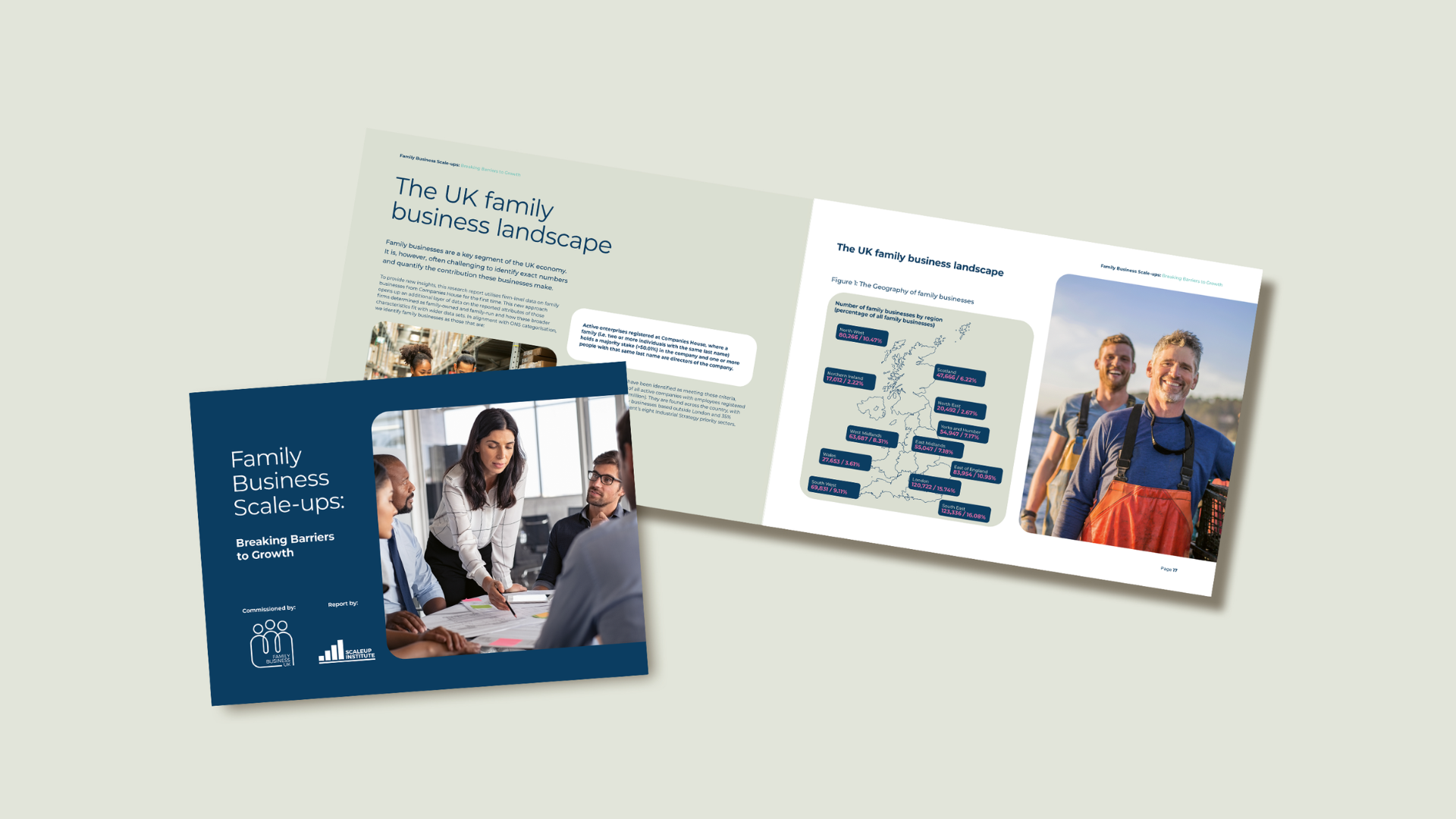
First-of-its-kind research from Family Business UK and the ScaleUp Institute has identified the number, importance and regional spread of Britain’s mid-market, scaling family businesses.

According to the research, these critical family-owned companies contribute £142 billion to the economy and employ more than 900,000 people. Scaling family businesses alone generate £72 billion and support half a million jobs.

In addition, they power Britain’s regional economies with almost 70% being located outside of London and the South East with the North West, South West and East of England all having significant clusters of mid-sized, scaling family firms. You can read and download the full report by clicking below.


Scaling UP


The report finds there are nearly 10,000 mid-market, scaling family businesses in the UK comprising:

  • 8,641 mid-market
  • 2,985 scaling
  • 1,765 are both mid-market and scaling

Both mid-market and scaling family firms are a critical presence supporting the Government’s industrial strategy with a significant proportion (28%) in advanced manufacturing with others spread across sectors including transport, digital technologies, the creative industries, cleantech and life sciences.

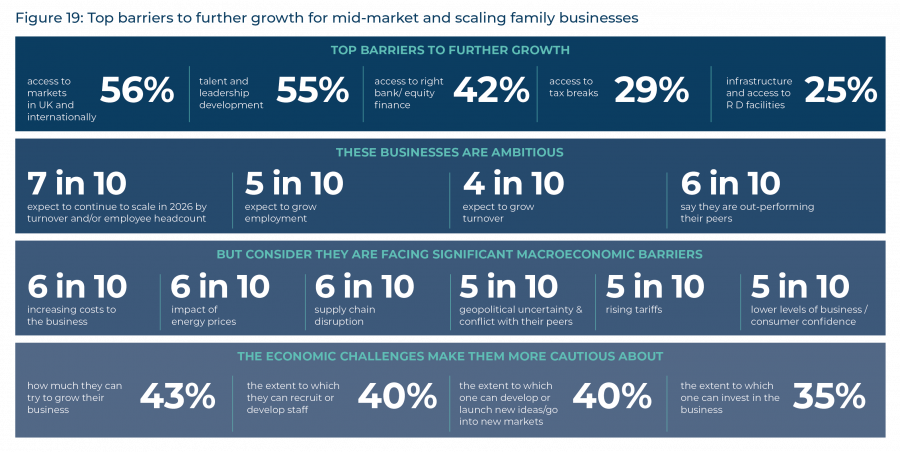
These mid-market, scaling family businesses are ambitious but face significant challenges to growth

To ensure these vital family businesses are supported to overcome these challenges, Family Business UK is calling for:

  • a new, shared definition of a medium-sized business – one with between 50-499 employees and turnover between £10million-£100million
  • a stable tax framework that incentivises growth and investment – including the full reinstatement (with no thresholds) of Inheritance Tax reliefs – BPR & APR
  • family businesses to be prioritised in regional growth plans
  • policies to ensure family businesses can access the finance and talent they need to grow.

Neil Davy, CEO Family Business UK said:

“The analysis we have done together with the ScaleUp Institute casts Britain’s family business sector in a new light. Too often characterised as ‘just small businesses’ these insights show the critical importance of family businesses to the economy – particularly the mid-market, scaling firms that are delivering both jobs and prosperity, and supporting key government strategies.

“Nevertheless, these family businesses are being failed by a policy landscape that is designed for other businesses. They have become the missing middle in business policy and that must change.

“This ground-breaking research makes a clear case for how policymakers should see and embrace these critical family businesses to ensure they thrive in a diverse and growth-orientated economic landscape.”

FBUK responds to PM stepping down

Commenting on the Prime Minister’s announcement that he will resign and set a timetable for handing over leadership of the Labour Party, Neil Davy, CEO Family Business UK said:

“The last thing Britain’s family businesses need is another summer of uncertainty and speculation. The process of selecting a new leader must be swift and the focus switch to one overriding priority: growth.

“Whoever becomes the next Prime Minister must be relentless in creating the policies and conditions that give businesses the confidence they need to invest, expand and create jobs.

“Britain’s five million family-owned businesses must be at the heart of that mission. Their long-term outlook, commitment to local communities and willingness to commit investment over decades makes them one of the country’s greatest economic assets, and government policy must reflect that.

“Our next Prime Minister must champion a stable, pro-business environment that unlocks investment, rewards enterprise and job creation, and gives Britain’s private and family-owned businesses confidence to plan for the future. We look forward to working with whoever becomes the next leader to build a stronger, more prosperous economy for generations to come.”

Latest magazine celebrates family business legacies

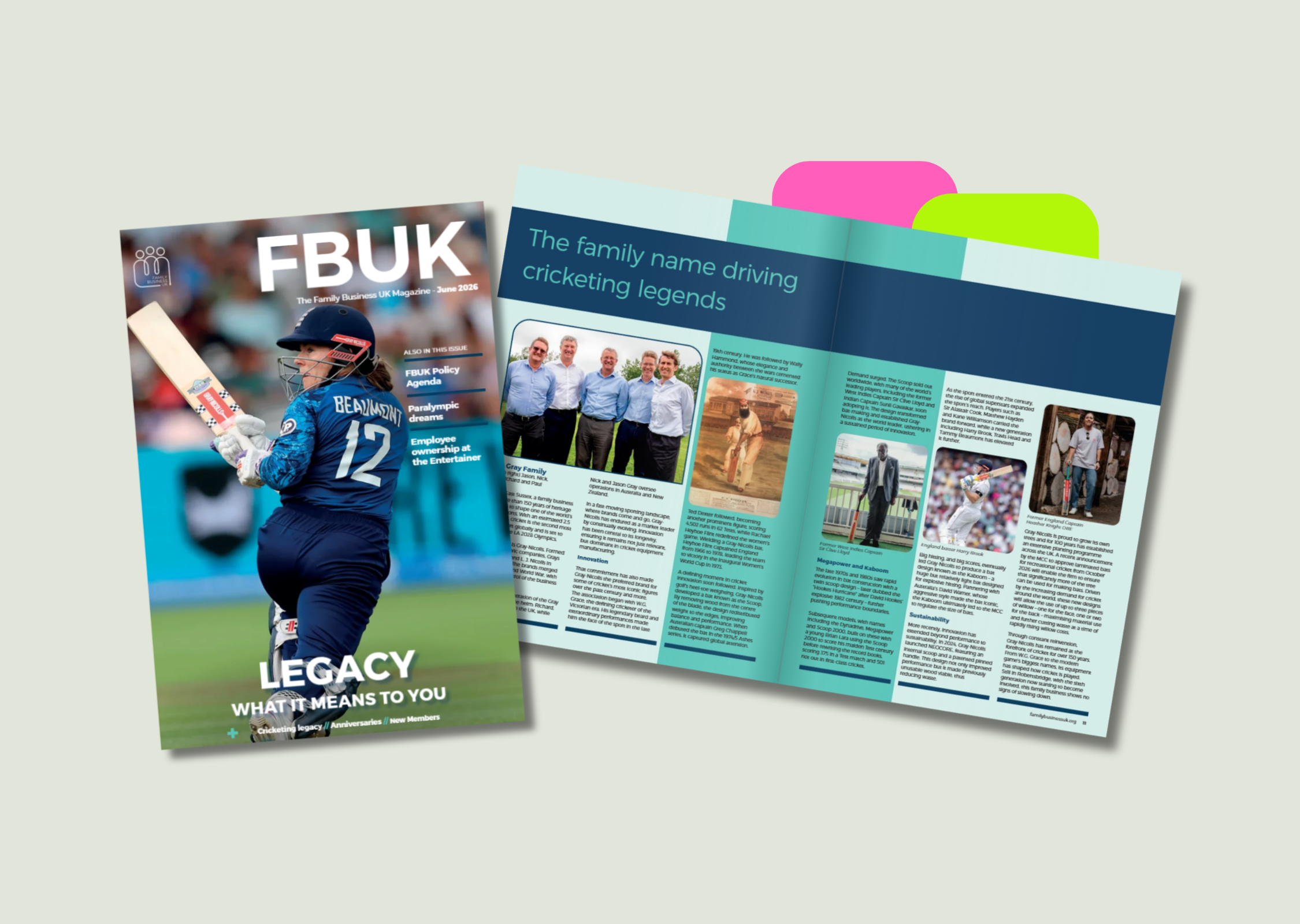
The latest edition of the Family Business UK magazine has been published. Coinciding with our 25th anniversary Annual Conference, this latest edition explores what legacy means to family businesses.

From the insights of four very different family businesses that share more than 1,200 years in business to the cricketing legacies created by the famous Gray-Nicolls family and the family business employee who’s made Paralympic history – we learn that legacy is easy to see but not always so easy to define.

You can read the latest edition online (best in full screen), or download it by using the digital edition below.


FBUK Magazine Issue 7 June 2026

Also in this edition, we talk to Duncan Grant about why the Grant family felt the time was right to exist from the Entertainer group and set up an Employee Ownership Trust.

We dive into the new FBUK Policy Agenda and hear from the Wates Group Chairman, Tim Wates, on the need to create a policy environment that empowers and supports mid-size family-owned businesses.

We meet some of the newest FBUK Members and celebrate a collective 500 years in business from three FBUK Members.

Why not get involved?

We are always keen to hear your news and opinions, and get your ideas for stories we should be covering in the magazine. Why not drop us a note by emailing our Communications Director Martin Greig

Advertise in our magazine

Showcasing your brand, products and services in the FBUK magazine is the perhaps the quickest way and most cost-effective way of reaching the families running Britain’s family businesses. If you’re interested and would like to speak to the team, contact our Marketing Manager Melissa Saunders.

FBUK joins government taskforce

Family Business UK Chief Executive, Neil Davy, has been invited to join a new government taskforce aimed at reducing the administrative burden on small and medium-sized enterprises.

The Small Business Taskforce will be co-chaired by Blair McDougall MP, Minister for Small Business and Economic Transformation and Tina McKenzie MBE, Chair of Policy and Advocacy at the Federation of Small Businesses.

The Taskforce follows a government consultation, supported by FBUK Members, to design a plan for small businesses. The taskforce will now take forward this work, engaging directly with businesses to identify improvements to regulation and ways in which administrative burdens can be reduced.

Commenting on FBUK’s involvement in the Taskforce, CEO Neil Davy said:

“In recent years we have worked hard to put the voice of family businesses at the heart of policymaking. Family businesses are a critical but often overlooked segment of our economy. It is vital their unique contribution to the economic and social fabric of the country is better understood and supported. That recognition must be consistent across government departments and the design of regulatory systems must fully understand the unique model of family ownership.

“Our policy work in recent months has highlighted a consistent theme among family firms—the cost and administrative burden of simply doing business must be reduced. It is just one of the key recommendations in our Policy Agenda—alongside putting family businesses first—creating a fiscal and regulatory environment that both supports them and incentivises them to invest for the future.

“I look forward to taking forward the work of the Taskforce, to hearing from our Members and family businesses across the country to identify ways in which government can better support them to continue building Britain for generations.”

Members of the Taskforce include:

  • Blair McDougall MP (co-chair), Minister for Small Business and Economic Transformation
  • Tina McKenzie (co-chair), Chair of Policy and Advocacy at Federation of Small Businesses (FSB)
  • Michelle Ovens CBE, founder of Small Business Britain.
  • Polly Dhaliwal, Chief Operating Officer at Enterprise Nation.
  • Neil Davy, CEO of Family Business UK.
  • Charlotte Keenan, Managing Director at Goldman Sachs.
  • Dr Roni Savage, CEO and Founder of Jomas Associates, Business and Trade Non-Executive Director.
  • Joshua Toovey, Head of Policy and Research at the Association of Independent Professionals and the Self‑Employed (IPSE).
  • Kate Shoesmith, Director of Policy and Insight at the British Chambers of Commerce
  • Iain Wright, Chief Policy and communications officer Institute for Charter Accountants for England and Wales (ICAEW)
  • Ed Woodall, CEO of Association of Convenience Stores (ACS)
  • James Caroll, No10 Special Advisor
  • Emma Jones CBE, Small Business Commissioner
  • Katie Martin, Business Advisor to the Financial Secretary to the Treasury

FBUK welcomes support for scaling businesses

FBUK has welcomed a new package of measures announced by the Government to help ambitious businesses start, scale and grow in the UK.

Unveiled by the Secretary of State for Business and Trade, Peter Kyle, at London Technology Week, the package is designed to strengthen the UK’s scale-up ecosystem and includes measures to improve access to talent, investment and government support for high-growth businesses.

Read the Government’s announcement here.

The package of measures include: 

  • a concierge service to help high-growth businesses navigate government support, regulation, finance, procurement and talent challenges,
  • a new visa reimbursement scheme to help scaling businesses attract world-class talent in sectors including digital technology, life sciences and clean energy,
  • a pilot programme to strengthen the UK’s scale-up pipeline through a new private sector delivery partner.
  • The appointment of a dedicated government Scale-up adviser to help ensure support reflects the needs of growing businesses.

Notably, the package includes a new concierge service for growing businesses, an approach advocated by FBUK in its recently published Policy Agenda, Building Britain for Generations, which calls on government to adopt a targeted strategy to support the growth and resilience of medium-sized firms

Commenting on the announcement, FBUK Chief Operating Officer Fiona Graham said:

“The UK has a significant untapped scale-up opportunity sitting within its family business sector. Many family-owned firms have the ambition, resilience and long-term outlook needed to grow, invest and create jobs but too often they face barriers when trying to access support, finance or navigate government programmes.

“That is why Family Business UK has called for a dedicated concierge service for medium-sized businesses, providing a single front door to support programme, investment routes and regulatory guidance. We welcome the Government’s decision to move in this direction and are pleased that ministers have heard our calls. 

“If we are serious about boosting productivity and growing the economy, we need to ensure that family businesses are fully supported to scale. Unlocking that potential could deliver significant benefits for local economies and communities right across the United Kingdom.”

FBUK calls for rethink on high costs of employment

  • Employment costs and rising prices holding back family businesses
  • National Insurance plus National Minimum / Living Wage having biggest tax impact on family firms
  • Family Business UK says government must look to reduce these burdens to create environment for growth and investment

Family Business Pulse Q2 2026

New research published by Family Business UK paints a mixed picture of a family business sector being squeezed by higher costs. While firms remain confident and eager to invest for the future, increasingly high costs of employment and rising prices, driven by geopolitical uncertainty, are holding them back.

The research, which forms the basis of a new quarterly Family Business Pulse report which tracks sentiment and activity amongst Britain’s family firms, shows that almost half of family businesses (47%) say either higher National Insurance Contributions or the increased National Minimum and Living Wage are having the biggest tax impact on their business. Together with high wage expectations, rising employment costs represent the biggest barrier to family firms taking on new staff.

According to the research, more than two fifths of family businesses (41%) say that government support with high costs of employment would be the best way support them create new roles and recruit staff over the next 12 months. A further 35% want greater stability and predictability in employment regulation.

Recruitment and expansion amongst family businesses is also being hit by uncertainty caused by the ongoing conflict in the Middle East. More than one fifth (22%) of family businesses say they have delayed hiring and expansion plans because of global instability while one in six (16%) has been forced to cut jobs.

Neil Davy, CEO FBUK said:

Family businesses have been building Britain for generations but, right now, they feel stuck in limbo being squeezed on all sides by the permanently higher costs of employing people, and temporary cost increases from ongoing geopolitical uncertainty.

Family firms remain eager to grow employment, but cost and uncertainty are forcing them to make unpalatable choices—to cut back on recruitment more than they would like and, in some cases, reduce headcount.

If we are to reverse this situation and allow businesses to create the opportunities workers need there must be a renewed focus on reducing the burden of National Insurance Contributions along with careful management of the National Minimum and Living Wages. We would like government to commit to moving towards a fixed three-year review cycle and introduce stronger fiscal incentives to get young people into work.

The research for the Family Business Pulse report also shows the extent and impact on Britain’s family business sector of rising prices driven by conflict in the Middle East.

More than four in ten (43%) family businesses say instability has pushed up costs in areas including fuel, raw materials, shipping and insurance. Of these, one third (34%) say prices have risen between 10%-19% while one in five (22%) says prices are up between 20%-29%. Almost one in ten family businesses (9%) are reporting costs increases between 30%-39%.

More than a third (37%) of family businesses have adjusted prices to customers to reflect their own higher costs. Other impacts include:

  • 27% of family firms are reporting difficulties with supply chains
  • 24% of family businesses say ongoing uncertainty is affecting long-term planning
  • 19% report lower customer demand in key markets
  • 18% say finance costs have increased
  • 16% report difficulty accessing international markets

Inheritance Tax continues to cause major challenges for most family businesses, according to the research, with more than half (51%) saying they will still be affected despite investing time and money in legal and tax advice over the last 12 months.

Medium and large family businesses remain the most likely to be affected with more than 60% of all family businesses employing more than 50 people saying they will be hit.

Almost four in ten (38%) medium and large family businesses say the future growth of their business would be supported by reforming rules on Inheritance Tax, which were introduced on 6 April.

Neil Davy continues:

Just when growing the UK economy and supporting British enterprise should be the Government’s priority, this specific tax policy imposed on British family businesses is achieving the opposite—forcing them to look inwards rather than focus on growing their business and creating jobs across the country.

Family businesses are the lifeblood of local economies across the country and are critically important to thriving communities. With the Budget just five months away, the Government must look at the priorities highlighted in our Family Business Pulse report and create a fairer—and simpler—tax system that supports family businesses and unlocks their potential to deliver the increased opportunities and economic growth our country needs.