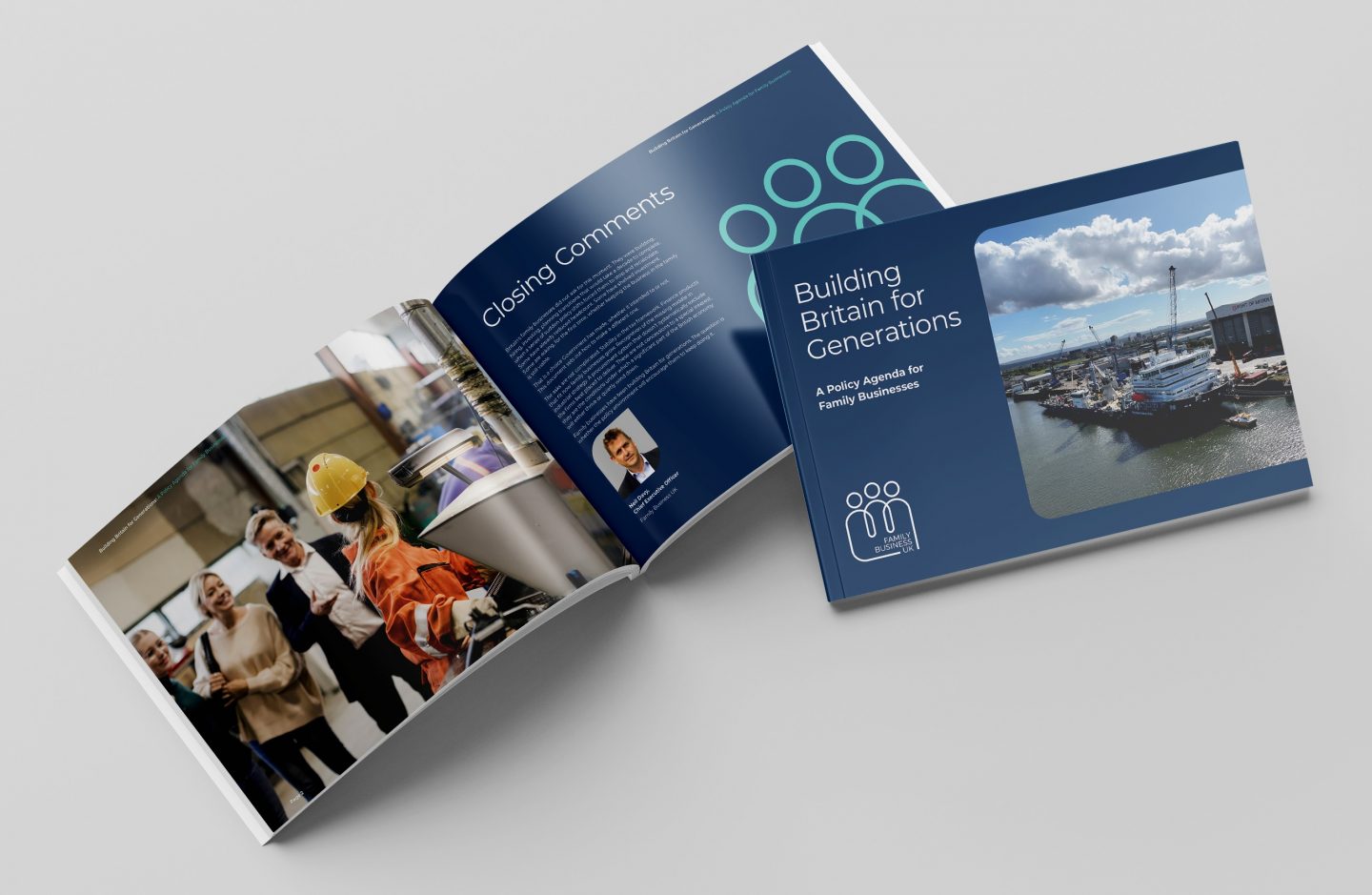
FBUK has published a new policy agenda for family businesses. Coming ahead of local elections around the UK and ongoing geopolitical uncertainty, Building Britain for Generations highlights key areas for policymakers, prioritising stability, long-term growth, investment and stewardship – all traits of family businesses.
The policy agenda calls for government, politicians and all policymakers to adopt a ‘FAMILY first’ approach that encompasses:
- Fair taxation system
- Accessing finance and business support
- Mid-sized family business focus
- Investing in local communities
- Lowering the cost of doing business
- Younger generation focus
FBUK Policy Agenda - Building Britain for Generations
The policy agenda, which was launched at an event in London, proposes a comprehensive set of recommendations that place the UK’s five million family businesses, and the benefits of family ownership, at the heart of efforts to grow the economy and tackle critical issues including youth unemployment.
Policy asks include:
- Appointing a family business czar in every devolved nation and region to support long-term investment in communities and support greater fiscal devolution,
- Targeted measures to tackle youth unemployment including an exemption from employer NICs for all family businesses offering Level 4 and above apprenticeships in AI, leadership and management,
- A clear ‘tax roadmap’ – that gives family businesses confidence about the direction of travel, removes the fear of sudden, damaging surprises and enables long-term investments,
- Full reinstatement of 100% Inheritance Tax reliefs (BPR and APR) for family firms, with no thresholds,
- A simplified procurement system that places greater weight on long-term investment and delivery, regional investment and social cohesion.
The new policy agenda also calls on government to adopt a new definition of medium-sized businesses to support the forgotten engine of the UK economy. This should be companies with revenues between £10million-£100million and between 50-499 employees (mid-size is currently defined as fewer than 250 employees and less than £54million revenue).
FBUK research shows there are 10,000 mid-sized family businesses in the UK which employ 1.5 million people and create £140 billion economic output. But these established businesses remain largely invisible to policymakers and are held back by a policy environment designed for either small or large companies.
Neil Davy, CEO Family Business UK said:
“Family businesses are established pillars of Britain’s towns and cities in a way that global brands can never be – they have built a brand, reputation and workforce there, and often it’s the family name above the door.
“Yet the current policy system often favours foreign investment over established, British family businesses with the lure of lucrative tax breaks and other incentives not available to family firms. That has to change if the UK is serious about a robust domestic economy that delivers sustainable, long-term growth.”
The new family business policy agenda, which is launched on the eve of the most significant change to the taxation of British family businesses in 50 years (BPR and APR), also highlights the ongoing impact of the change to inheritance tax reliefs on family businesses:
- The majority of family businesses (57%) say they will still be materially affected by IHT (despite changes announced by government on 23 Dec),
- Just 1 in 10 family businesses believe they will escape the tax entirely,
- Just 74% of family businesses are confident they can remain family-owned in 10 years’ time (down from 91% in the next 3 years) with increasing concerns that the burden of IHT will force businesses to sell up or sell assets – often to foreign-owned corporations – creating further instability for the domestic economy.
But FBUK’s research also shows the positive impact that fully reinstating BPR and APR could have, with almost half (48%) of Britain’s large family businesses saying they would reverse hiring decisions and actively recruit more staff.
Neil Davy continues:
“Recent, sudden policy shifts have forced Britain’s family businesses to pause and recalculate long-terms plans for the future. Some have reduced jobs, other have cut investment and, for the first time, some are asking whether keeping the business in the family is still viable.
“This is a consequence of a choice made by the Government-whether it intended to or not. This policy agenda sets out how it can make a different one. The asks are not complicated, nor are they concessions to a special interest. They are simply the conditions under which a critical part of the British economy will be allowed to thrive.”